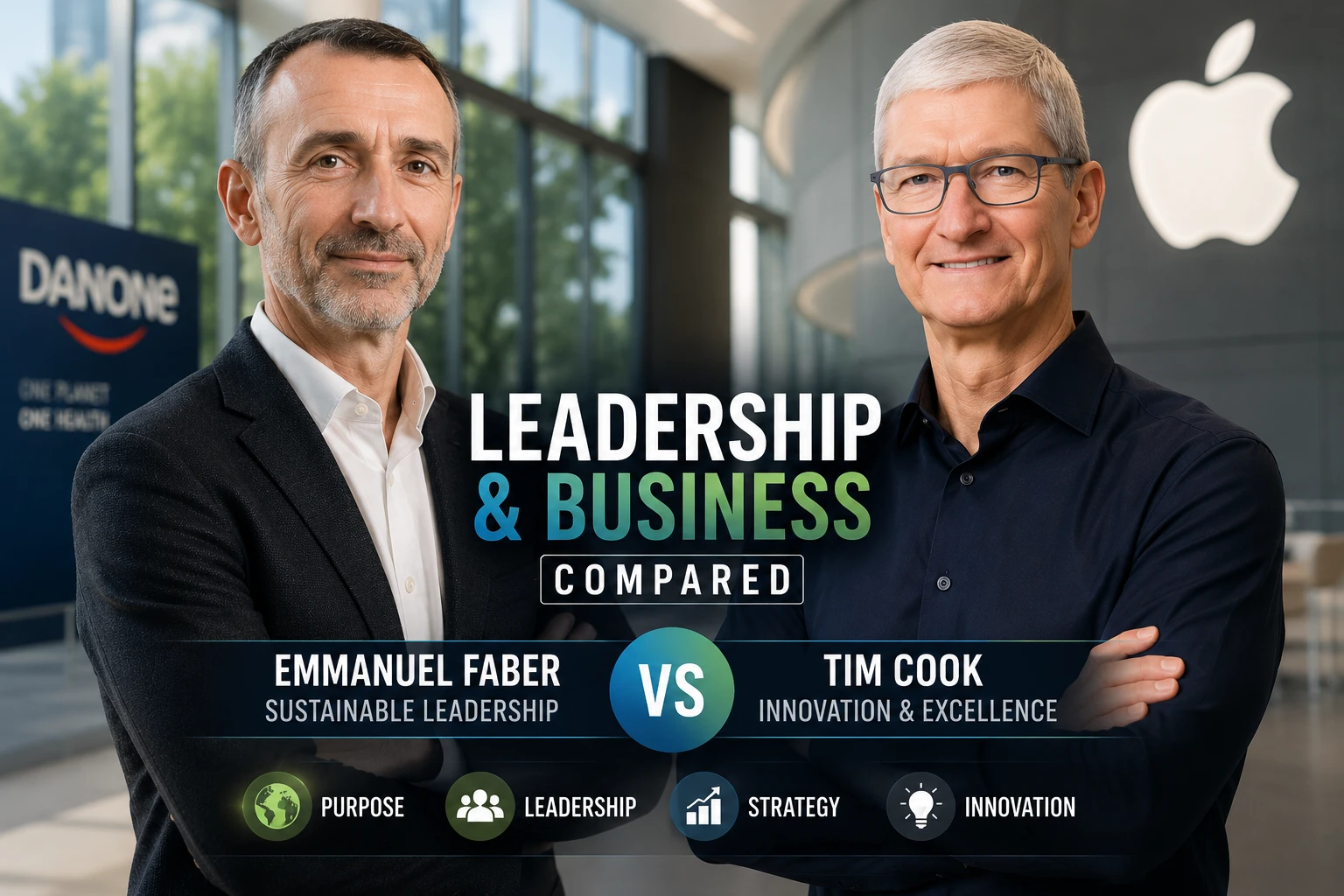
Emmanuel Faber And Tim Cook: Leadership and Business Compared
Emmanuel Faber and Tim Cook built distinguished careers by leading major organizations through periods of significant commercial and social change. Their paths, however, developed around very different priorities.
Faber became known for sustainability, inclusive growth, and corporate responsibility during his years at Danone. Cook built his reputation through operations, supply chains, technology products, and Apple’s enormous global ecosystem.
Their careers offer an unusual comparison between sustainability-focused leadership and technology-driven corporate management. Both executives also demonstrate how leadership can evolve after leaving a major operating role.
The Rise To Power: Emmanuel Faber
Early Education And Professional Training
Emmanuel Faber was born in Grenoble, France, in 1964 and graduated from HEC Paris in 1986. His education provided a foundation for finance, management, and international business.
Faber began his professional career at Bain & Company before moving into investment banking with Baring Brothers. These early positions gave him experience across consulting, finance, corporate strategy, and investment analysis.
His early career differed considerably from Cook’s operational background. Faber initially developed through finance and advisory work before moving into corporate management within major industrial organizations.
Building A Career At Danone
Faber joined Legris Industries in 1993 as chief financial officer and became managing director in 1996. He then joined Danone in 1997, taking responsibility for finance, strategy, and information systems.
He became Danone’s chief financial officer in 2000 and later moved into regional leadership. By 2005, he was vice president for Asia-Pacific operations, expanding his management experience across international markets.
Faber became deputy CEO in 2008 and vice-chairman of Danone’s board in 2011. His progression demonstrated a steady movement from financial management toward broader executive responsibility.
CEO And Chairman Of Danone
Faber became Danone’s CEO in 2014 and chairman of its board in 2017. His leadership increasingly connected commercial decisions with social, environmental, and stakeholder considerations.
One major transaction during his tenure was Danone’s 2017 acquisition of WhiteWave. The deal strengthened Danone’s position in plant-based food and beverage categories while expanding its international consumer portfolio.
Faber also supported initiatives involving inclusive growth, biodiversity, social investment, and sustainable agriculture. His corporate philosophy eventually became closely associated with a wider discussion about responsible business leadership.
The Rise To Power: Tim Cook
Education And Early Operations Experience
Tim Cook was born in Robertsdale, Alabama, in 1960 and earned a bachelor’s degree in industrial engineering from Auburn University. He later completed an MBA at Duke University’s Fuqua School of Business.
Cook spent twelve years at IBM before moving to Intelligent Electronics. He subsequently joined Compaq as vice president for corporate materials before making his most consequential career move.
In 1998, Cook joined Apple as senior vice president of worldwide operations. His arrival occurred when Apple was rebuilding its business under Steve Jobs.
Transforming Apple’s Operations
Cook became responsible for worldwide sales and operations, including Apple’s supply chain. His operational approach helped Apple improve inventory management and coordinate manufacturing across an increasingly global network.
He later became Apple’s chief operating officer and served as one of Jobs’ most important senior executives. Cook’s strength was less about public product presentation and more about making Apple’s enormous operational system function effectively.
His career demonstrates how operational discipline can become a major source of competitive advantage. The comparison with Carlos Slim’s approach to business ownership and wealth creation highlights another example of management systems supporting enormous commercial scale.
Becoming Apple’s CEO
Cook became Apple’s CEO in August 2011 after Jobs stepped down. Taking over from one of the technology industry’s most influential founders created enormous expectations.
Rather than attempting to imitate Jobs, Cook developed his own leadership approach around execution, operations, services, capital returns, and Apple’s global ecosystem. Apple expanded substantially during his tenure.
The company increased its focus on services, wearables, subscriptions, and international markets. Products such as the Apple Watch and AirPods became major additions to Apple’s broader hardware portfolio.
Differing Philosophies On Success And Leadership
Sustainability And Stakeholder Thinking
Faber’s leadership philosophy placed substantial attention on environmental sustainability and social responsibility. His work at Danone reflected an effort to connect corporate performance with wider stakeholder interests.
He later became the inaugural chair of the International Sustainability Standards Board in 2022. The ISSB was established to develop global sustainability disclosure standards for capital markets.
Faber’s transition from corporate CEO to sustainability standards leader extended his influence beyond a single company. His work increasingly focused on how businesses communicate environmental and social information to investors.
Operations And Shareholder Value
Cook’s leadership has emphasized operational excellence, product execution, financial performance, and shareholder returns. Apple’s scale requires highly coordinated decisions across manufacturing, logistics, software, retail, services, and finance.
His management style is generally less associated with dramatic public speeches and more associated with disciplined execution. Cook’s background in industrial engineering and operations remains visible in how Apple manages its global business.
This approach differs sharply from Faber’s emphasis on sustainability reporting and stakeholder considerations. Yet both approaches depend on measurable performance, organizational discipline, and long-term planning.
Leadership After The CEO Role
Faber’s post-Danone career shows how an executive can move from corporate management into global institutional leadership. His ISSB position placed him at the center of worldwide discussions about sustainability disclosures.
Cook’s next transition also illustrates how senior leaders can evolve after long CEO tenures. Apple announced that Cook would become executive chairman on September 1, 2026, while John Ternus would become CEO.
Cook’s continuing involvement is expected to include engagement with policymakers worldwide. This transition gives Apple a new operating leader while retaining Cook’s experience at the company’s highest governance level.
Expanding Empires And Commercial Ventures
Danone’s Consumer Portfolio
Faber’s Danone career involved managing a company with major positions in dairy, plant-based products, bottled water, specialized nutrition, and other food categories. The company’s portfolio provided exposure to changing consumer preferences.
The WhiteWave acquisition represented one of the clearest examples of strategic portfolio expansion under Faber. It strengthened Danone’s presence in plant-based food and beverage markets.
Faber’s approach connected commercial growth with changing consumer expectations around health and sustainability. His leadership therefore combined traditional consumer-business management with broader environmental and social concerns.
Apple’s Expanding Ecosystem
Cook inherited a company centered heavily on hardware but helped expand its recurring services and connected-device ecosystem. Apple’s services business became increasingly important alongside the iPhone.
Apple also expanded categories including wearables, payments, subscriptions, entertainment, cloud services, and digital content. These businesses increased the number of ways customers interact with Apple’s ecosystem.
The result was a business model that increasingly depended on relationships between hardware, software, and services. Cook’s tenure therefore extended Apple’s commercial reach without abandoning its core product strategy.
Acquisitions And Strategic Investments
Faber’s most prominent acquisition at Danone was WhiteWave, which significantly increased the company’s exposure to plant-based consumer products. The transaction also reflected broader changes in food consumption patterns.
Cook’s Apple completed the $3 billion acquisition of Beats in 2014. The deal brought Beats Electronics and Beats Music into Apple and strengthened its position in headphones and music services.
These transactions reveal different forms of corporate expansion. Faber used acquisition to reshape a food company’s category exposure, while Cook used acquisition to reinforce Apple’s consumer technology ecosystem.
Where Their Worlds Intersect
Managing Global Organizations
Both executives operated organizations with international workforces, complex supply chains, and customers across multiple markets. Their decisions therefore carried consequences far beyond their headquarters.
Faber managed Danone during debates surrounding sustainability, food systems, and responsible capitalism. Cook managed Apple through major changes in technology consumption, global manufacturing, and digital services.
Their responsibilities demonstrate how multinational leadership requires coordination between financial performance and broader external pressures.
Public Reputation And Corporate Identity
Faber became strongly associated with sustainable capitalism and stakeholder-oriented business thinking. His public profile increasingly centered on environmental reporting, inclusive growth, and responsible corporate governance.
Cook became one of the most recognizable corporate leaders in technology. His public identity remains closely connected with Apple, privacy, supply-chain management, product launches, and the company’s relationship with governments.
Their public roles differ, but both show how an executive’s personal reputation can become connected to corporate values.
Technology, Media, And Cultural Influence
Cook’s influence is directly connected to products used by hundreds of millions of people around the world. Apple’s devices and services have shaped communication, entertainment, commerce, and personal technology.
Faber’s influence operates differently through corporate policy, sustainability standards, and discussions about how companies report their environmental and social impacts.
A related comparison involving global corporate leadership and entertainment influence shows how professional reputations can develop through completely different industries while reaching international audiences.
Frequently Asked Questions
Who Is Emmanuel Faber?
Emmanuel Faber is a French business executive who served as Danone’s CEO and chairman before becoming the inaugural chair of the International Sustainability Standards Board.
Who Is Tim Cook?
Tim Cook is an American business executive who became Apple’s CEO in 2011 after holding senior operational positions at the company. He is scheduled to become Apple’s executive chairman in September 2026.
What Is Emmanuel Faber Known For?
Faber is known for his leadership at Danone and his strong focus on sustainability, inclusive growth, and responsible business practices. He later became a leading figure in global sustainability reporting standards.
What Is Tim Cook Known For?
Cook is known for leading Apple through major growth in hardware, services, wearables, and international markets. His operational background also shaped Apple’s supply-chain and business management systems.
How Are Emmanuel Faber And Tim Cook Different?
Faber’s career became strongly associated with sustainability and stakeholder-oriented corporate leadership. Cook’s career has focused more heavily on operational execution, technology products, services, financial performance, and shareholder returns.
Final Takeaways
Emmanuel Faber and Tim Cook demonstrate two different models of modern corporate leadership. Faber moved from financial management into sustainability-focused leadership, while Cook built his reputation through operations, technology, and Apple’s global commercial system.
Their careers also show that executive influence does not end when someone leaves a traditional CEO position. Faber now shapes sustainability reporting standards internationally, while Cook prepares for Apple’s executive chairman role after fifteen years as CEO.